

Moving to Coeur d'Alene from Boise
Moving from Boise to Coeur d'Alene is an in-state move with no income tax change — Idaho's 5.8% top rate applies on both ends, and Kootenai County's effective property tax (around 0.60% with the homestead exemption) is slightly below Ada County's 0.63%. The Boise-to-CDA buyer typically trades Treasure Valley sprawl for water, forest cover, and a measurably wetter winter — about 70 inches of snow a year versus Boise's intermittent dustings. The job market is smaller and downtown energy is thinner; the recreation footprint is dramatically larger.
Same state, different climate and culture — what Boise residents should know about North Idaho before relocating.
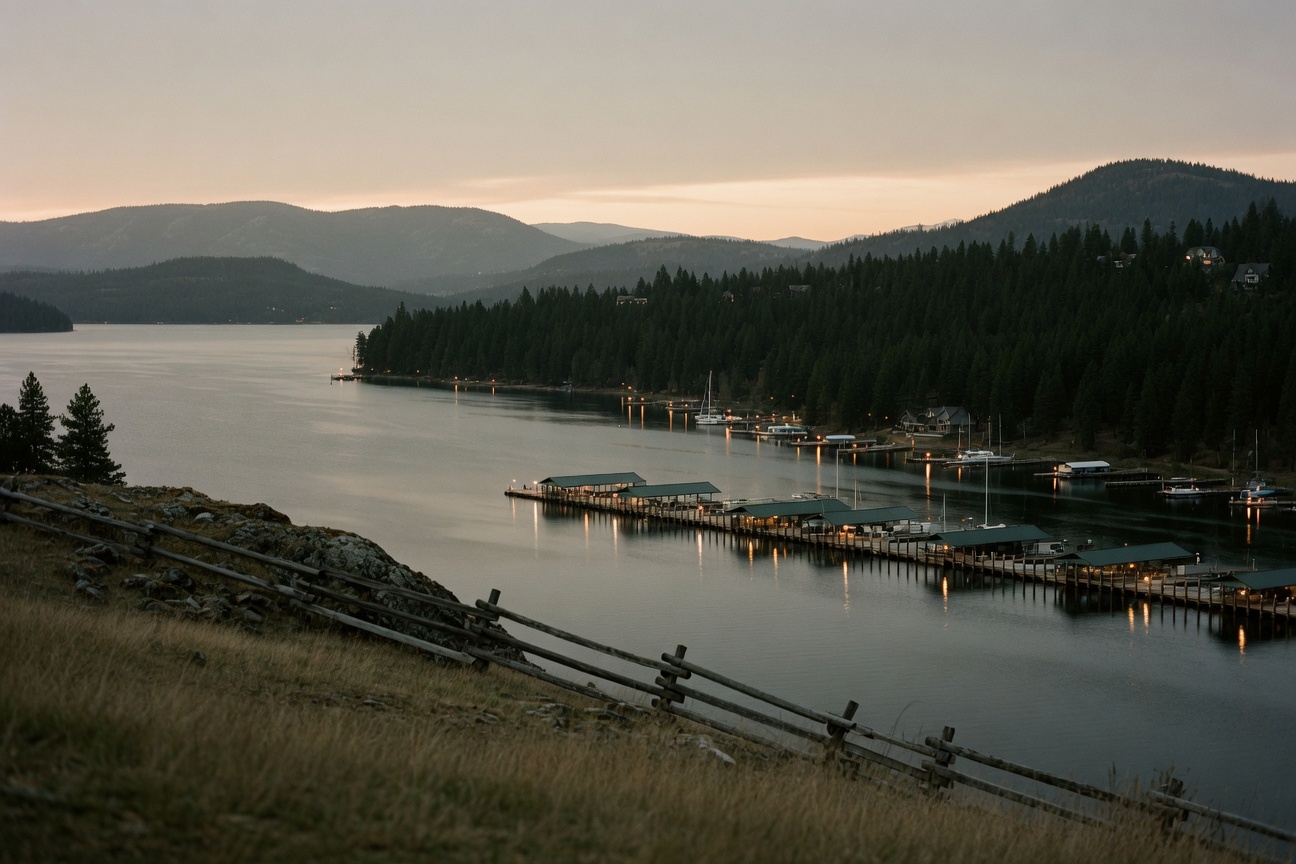
◦ The signalSame state-tax structure, dramatically more water and forest, no Treasure Valley sprawl
The Boise-to-CDA move is the in-state migration nobody talks about. It’s not a tax move (Idaho’s structure is uniform) and not an equity move (prices are within shouting distance) — it’s a lifestyle move, almost always driven by water access and a desire to step out of the Treasure Valley’s growth pattern. The buyers are usually mid-career or pre-retirement, often with grown kids, and the calculus is whether they want their default weekend to start at a boat ramp or a trailhead.
What changes
Daily life shifts in ways that don’t show up in cost-of-living comparisons. The Treasure Valley’s east-west sprawl — Meridian, Eagle, Star, Kuna — gets replaced by a north-south corridor anchored by I-90: Coeur d’Alene at the south end, Hayden and Rathdrum in the middle, Sandpoint another 45 minutes north. The driving feel is smaller and tighter; you’ll see the same plates regularly. The recreation pivot is the big one — Bogus Basin’s day-skiing template gives way to Schweitzer’s bigger-mountain template, and the high-desert riding economy is replaced by the lake-and-river economy. Downtown energy is thinner, especially November through March, and the dining ceiling drops; CDA’s summer downtown is real, but winter Tuesdays are quiet.
Where they land
Four corridors absorb most Boise buyers. Lakefront — Lake Coeur d’Alene and Hayden Lake — pulls the upgrade buyer who’s stepping into the recreation tier, typically $1.2M+ entry on Hayden and $1.5M+ on Lake CDA proper. Hayden’s residential suburbs (Avondale, the Hayden Lake area, Brunner) pull the family buyer with school-age kids — comparable to Eagle in feel, with better water access. Post Falls newer construction (Riverbend, Prairie Falls) is the cleanest 1:1 swap for an Eagle or Star home: same build vintage, comparable price, similar suburban template. The Rathdrum corridor north of CDA along Hwy 41 pulls buyers who want acreage and the closest thing to Eagle’s exurban feel — 1-5 acre parcels with forest cover, 25 minutes from CDA proper.
What it costs
The dollar comparison is unusually flat for a relocation page. Ada County’s median is roughly $535,000 against Kootenai County’s $545,000 — within rounding error. Property tax is similarly close: Ada’s effective rate runs about 0.63% with the homestead exemption applied, and Kootenai is about 0.60%. On a $550,000 primary residence, that’s $3,300/year in Kootenai versus $3,500 in Ada — a small savings, but not a move-the-needle one. State income tax is identical (Idaho’s 5.8% top rate applies everywhere in the state), sales tax is identical (6%), and the marginal effective property tax rate at higher price points converges around 0.75-0.8% in either county. The honest framing for the Boise buyer: this is not a financial-arbitrage move. Where the math shifts is the lifestyle premium — if you’d otherwise spend $200K and four years building a McCall second home for lake access, buying primary in Hayden gets you 12 months of usage instead of three.
The honest catch
The trade-offs are real and worth naming. The job market is meaningfully smaller — Boise’s tech and state-government layer (Micron, HP, Idaho state agencies, St. Luke’s/Saint Alphonsus) doesn’t exist at the same scale in North Idaho. Kootenai Health is the regional anchor on the medical side; private employers are dominated by construction, healthcare, and small business. The flight schedule is comparable in size to BOI but routed differently — GEG has stronger PNW connectivity, BOI has stronger Mountain West. Downtown energy is the bigger lifestyle shift: Boise’s downtown is a daily-life ecosystem with the Basque Block, BoDo, and the foothills as a casual after-work option. CDA’s downtown is real but smaller, leans heavily on summer tourism, and quiets significantly in winter. The arts and dining scene is thinner — fewer chef-driven restaurants, smaller live music calendar, less curatorial gallery presence. And the winter is meaningfully wetter than Boise — about 70 inches of snow a year against Boise’s 18, with heavier cloud cover and longer duration. The relocators who thrive have a winter plan that doesn’t depend on the downtown calendar; the ones who don’t shrink their world to indoors for a quarter of the year.
How to think about timing
Two sequencing notes. First, school-year alignment: CDA District 271, Lakeland 272, and Post Falls 273 all start in late August. Target closing June through early August so kids start the school year in-district. Second, the dock-permit window if you’re buying lakefront: Idaho Department of Lands processes encroachment permits in months, not weeks, and Tribal waters (south two-thirds of Lake Coeur d’Alene plus the lower St. Joe) have been under a restrictive posture since January 2022, with new dock construction heavily conditioned. Replacements of existing permitted structures remain routine. The practical implication: confirm the dock status of any waterfront property before writing the offer. An undocked lot, a non-conforming dock, or a dock on Tribal water with a pending permit issue can change the value of the property by six figures, and these are not facts the listing agent will always volunteer.
Questions buyers ask before the move.
Logistics & timing
How long is the drive from Boise to CDA?
About 6.5 hours via Highway 95 north — most Boise drivers take Hwy 55 to McCall, then 95 the rest of the way. The corridor is two-lane for long stretches and weather-dependent November through March (White Bird Hill, Whitebird Grade, Lookout Pass on the I-90 leg). Allow 7-8 hours in winter or with stops. Alaska flies BOI-GEG seasonally with one-stop options through SEA the rest of the year.Can I keep my Boise job and commute?
Not really — 6.5 hours each way is not a weekly commute. The viable structures are full remote, monthly fly-in (one connection through SEA), or relocating the job entirely. State agencies, banking, and tech employers based in Boise generally won't permit a Coeur d'Alene primary residence; healthcare and some construction trades have more flexibility. Most Boise-to-CDA moves involve a job change or retirement.What's the school comparison?
Coeur d'Alene District 271, Lakeland District 272 (Rathdrum/Spirit Lake), and Post Falls District 273 are the primary North Idaho options. Boise relocators usually compare against West Ada (Eagle/Meridian) — CDA-area schools are smaller, more rural in feel, and have less curricular depth (fewer AP/IB options, smaller specialized programs). The trade is more outdoor-education programming and smaller class sizes.How does GEG compare to BOI?
Roughly comparable size — both handle 4-5 million passengers a year, both have most major-carrier service. GEG has more direct service to Pacific Northwest cities (Seattle, Portland, Anchorage) and is closer to the lake corridor; BOI has stronger Mountain West connectivity (Denver, Salt Lake) and more nonstops generally. Neither has substantial international service — international itineraries connect through SEA or DEN.Do I need to re-register vehicles and update my driver's license?
No re-registration is required — it's an in-state move, so your Idaho driver's license and vehicle registration stay valid. You'll need to update your address with the Idaho Transportation Department within 30 days. Voter registration updates automatically when you change your DMV address. Homestead exemption needs to be reapplied at your new Kootenai County address; the Ada County application doesn't transfer.
Cost & taxes
What does Boise equity buy in CDA?
Roughly equivalent — Boise's median is around $535,000 and CDA's is $545,000, so a typical Eagle or Meridian sale buys a comparable Hayden or Post Falls home. The Boise buyer who wants to step up to lakefront ($1.2M+ entry on Hayden Lake, $1.5M+ on Lake Coeur d'Alene proper) is doing what they'd do at home: equity-plus-capital, not a free swap. The newer construction tier in Post Falls and Rathdrum is the cleanest 1:1 swap for an Eagle or Star home.What's the property tax difference between Ada and Kootenai Counties?
Very close — Ada County's effective rate runs about 0.63% with the homestead exemption applied, and Kootenai County is about 0.60%. On a $550,000 primary residence, that's roughly $3,300/year in Kootenai versus $3,500 in Ada, a small savings. The bigger property-tax variable is whether you're moving up the price tier: the homestead exemption (50% of value up to $125,000) caps quickly, so the marginal effective rate on a $1.5M home runs closer to 0.75-0.8% in either county.Is anything actually cheaper in CDA?
Some things, not many. Property tax is marginally lower. Auto and home insurance are roughly comparable. Groceries, gas, and utilities are within a few percent of Boise. The cost-of-living edge isn't a Boise-to-CDA story — it's a coastal-to-Inland-NW story, and Boise residents have most of that advantage already. The CDA move is about lifestyle and water access, not about saving money.What about state taxes — anything changes?
Nothing — same state, same 5.8% top income tax, same sales tax (6%), same vehicle registration structure. The only meaningful tax difference is the local property tax variance noted above. Idaho's Social Security exemption applies the same way in both counties for retirees.
Lifestyle & culture
What neighborhoods absorb the most Boise buyers?
Four corridors. Lakefront — Lake Coeur d'Alene and Hayden Lake — pulls the upgrade buyer who's stepping into the recreation tier. Hayden's residential suburbs (Avondale, Hayden Lake area, Brunner) pull the family buyer with school-age kids. Post Falls newer construction (Riverbend, Prairie Falls) is the cleanest swap for an Eagle or Star home — comparable build, comparable price. The Rathdrum corridor (north of CDA along Hwy 41) pulls buyers who want acreage and the closest thing to Eagle's exurban template.How does the recreation compare?
Different categories, both real. Boise's strength is mountain access (Bogus Basin, McCall, the Sawtooths), high desert riding, and a more robust trail-running culture. CDA's strength is water — 30,000 acres of Lake Coeur d'Alene, Hayden Lake, Spirit Lake, Priest Lake — and dense forest. Skiing is competitive (Schweitzer, Silver, 49 Degrees North vs Bogus and Brundage). The honest summary is that CDA is wetter and greener and Boise is drier and more high-desert; if your default weekend is water, CDA wins; if it's a mountain trail, Boise wins.Is the cultural shift meaningful?
Some, in both directions. Kootenai County is more conservative than Ada County, but only somewhat — both are right of state median, and Idaho-statewide cultural norms apply. The bigger shift is urban-to-rural: Boise has a downtown that supports a daily-life ecosystem (BoDo, the Basque Block, the foothills), and CDA's downtown is smaller, more tourist-oriented in summer, and quieter in winter. The arts and dining scene is thinner; the outdoor-recreation calendar is denser.What about the winter?
Real, and meaningfully wetter than Boise. CDA averages about 70 inches of snow a year against Boise's 18; the snow stays on the ground longer, and the cloud cover is heavier. December through February see daytime highs in the low 30s and overnight lows in the teens or single digits, similar to Boise — but with substantially more precipitation as snow. Studded tires and AWD are more necessary, not less. Ski areas are closer and bigger; the lake corridor adds lake-effect snow on top of the regional pattern.
Thinking about the move?
Send a note with the city you're leaving and the price band you're working with. We'll pull comps and walk you through the rest.